
Wandersong of Igashu
ἄστρον
"Do not, my Luari, become enthralled by the Sun's radiance, or the whispers of the Night's secrets. They will embrace you, and you shall ache in their absence."
Synopsis
Seat of Power: Gendarme upon Mount Stargon
Part of: None
People Name: Star Elves/Elf of the Stars (Estreli'Luari/Estrela'Lurin)
Adjective: Igashian (An Igashian sword)
Religion: The Wandersong
Language: High Lorathelian & Low Lorathelian
Introduction

“Let another light be the focus of your eyes and the stars shall fade from view.”
Known as the wandering nation, Igashu is filled with souls eager to learn more about the world and to get out and experience what Volantis has to offer. Holding a balance that their elven siblings cannot keep, the Wondersong strives to maintain a harmony in all aspects of their life. This culture of Viators, or Wanderers, can be found in the far flung reaches of the continent both on mountainpeak to valley depth, learning all that can be learned about others and experiencing it all; sometimes at the chagrin of the locals. With their eyes set on things above, their lofty ideals and goals created a philosophical society that has grown past reliance on divine powers. They are the Star Elves, the embodiment of the idea to be starry-eyed.
After establishing their own identity in succession of the numerous elven schisms, the Wandersong of Igashu have grand ambitions that reach to the stars. So long as there are things to discover and places to visit, the Estreli'Luari will venture forth to find their song and create an epic out of their lives on the stage of Volantis.
Physiology

Average for an elf, the Star Elves stand at around 6'9" for males and 6'5" for females, with weights averaging near 175/160 pounds respectively.
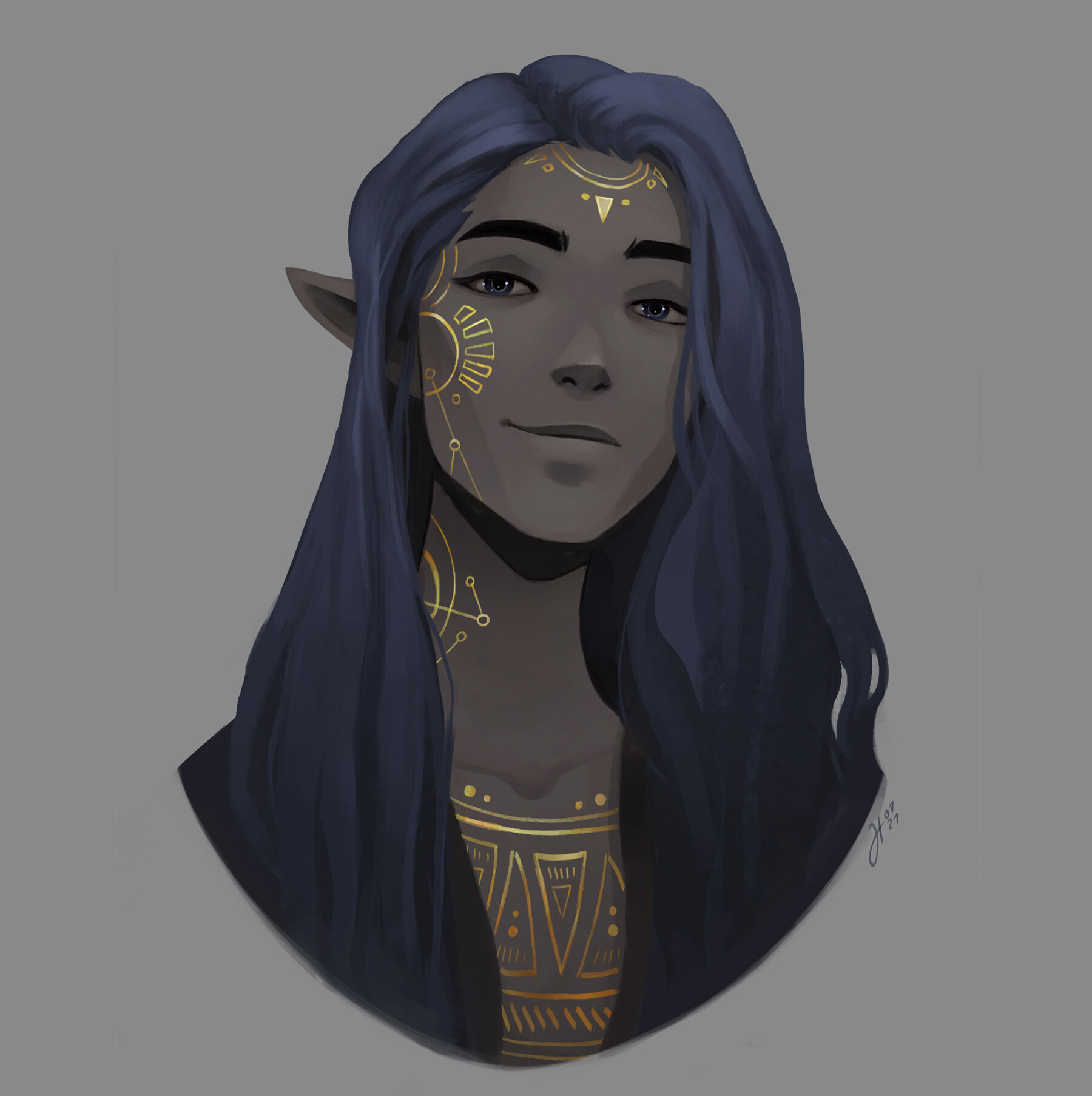
Being siblings to moon elves before the Settigris Schism, they have some striking similarities in certain ways, but are notably different in core appearances. Star Elves have skin tones of black/obsidian, with those closer to Moon Elven lineage having more of a dark grey skin tone. They lack any of the blue hues of their Moon Elven siblings. Stars, constellations and other iconography often adorn their skin in tattoos that glow under bare starlight, permanent retelling of their most cherished stories.
Eyes for an Estrela'Lurin look unique, in that like all elves their pupils are colors other than the black seen in all other mortals; for Star Elves, their pupils are a stark white. The irises are a range of blue, purple, pink or green colors.
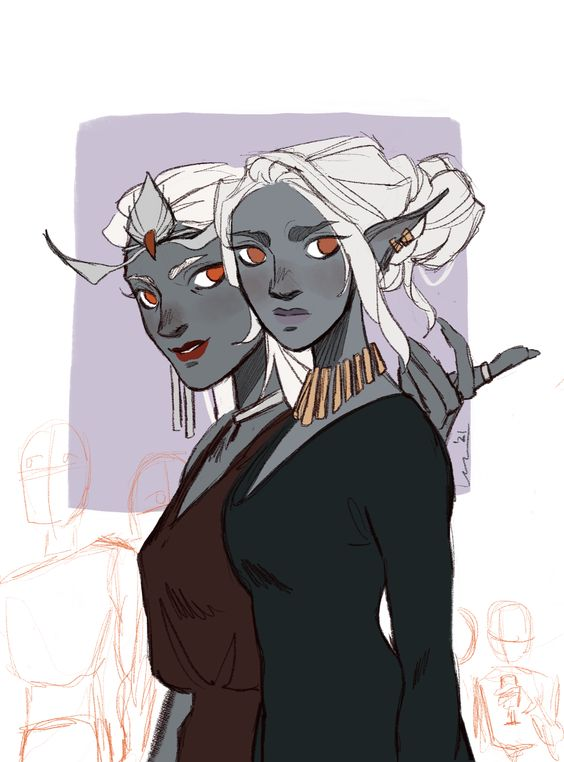
Hair colors are generally the same for these elves, being shades of light black, or very dark blues and purples. In rare occasions, white hair can be seen from those closer in lineage to Moon Elves. In either case, their hair will give off a subtle sparkle when under starlight, though very subtle.
Their ears plane entirely flat, in contrast to the high-rising ears of Sun Elves, and the dipping angle of Moon Elves. They have a sort of bounce to them, moving a bit extra when a Star Elf is in motion. These wanderers take pride in their ears, an expression of their ever-moving lives.
As with all elves, Star Elves do not need to sleep. They may choose to do so if they wish; truly said, the Wandersong harbors the sleepiest of elves. When they are not choosing to sleep, they are choosing to bask in nature, entering a meditative trance and enjoying what the stars above has for them today.
Fashion

“If you’re going to be traveling the world, you naturally must be the best dressed wherever you go.”
Igashian fashion toes the line between fashionable and functional. Described as fulsome, their attire is built upon travel clothes and robes that flow and enable a wide range of movement, while being colored and dyed with rich hues and colors. Many decorations and embellishments of various motifs to recount stories or simply cultural statements or even the flash of the stars above can be seen in their clothes, with small semi-precious stones dotting the rim of their sleeves.
The typical outfit of a Estrela’Lurin is the chupa, a type of wrapped jumper traditionally worn with added layers of aprons, woolen sashes and a panel coat. On the inside is a linen undershirt, and the outside a thicker felted wool, which is typically made in a modular fashion to be removed at the hip for warmer travels. The sleeves are generally wide, with the collar being high. Necks tend to be ornamented with decorative knots or clasps. The robe reaches down to the ankles and allows for a loose, comfortable fit and freedom of movement, essential for their “always on the go” lifestyle.
These chupa are often woven with what the elves call memorial tapestries, a cultural practice all elves follow. The Star Elves reconstitute the typical cultural trend of weaving one's heritage and history into cloth by means of clothing. Their clothes often feature stories and recollections of their far-flung travels, growing more elaborate at the conclusion of each venture.
Females often wear an ornamental drape of white needle lace over their hair with studded stones on the edge, especially when traveling - which is to say most of the time. Special semi-precious stones are set for different occasions, and in rare instances in their life (such as marriage, homesteading, or specific political events) dyed lace is employed. Some may choose to keep the cinched sash around the waist that is part of the Moon Elven culture they used to be a part of.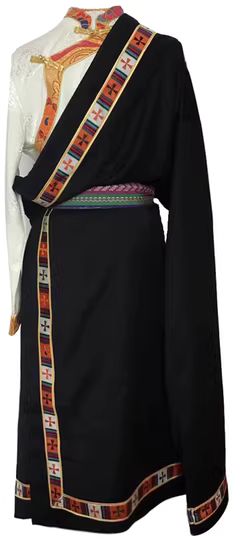
Naturally, as they are always moving and going, it is of little surprise that an Estrela’Lurin is heavily invested in their footwear. Whether it be boots for rough terrain or sandals for sandy environments or laced shoes for city life, a Star Elf has the right foot forward when it comes to appropriate shoes. In more harsh travel conditions they wear fashionable spats, or gaiters for wet areas. They like to collect small trinkets and keep them with them as they travel, attaching small mementos or crafted pins for the straps of their footwear.
Their color schemes include black, gold, green, navy and cobalt, terracotta, soft pink, light lilac, crimson, and taupe.
Cottons, linens and wools are used in their textiles, but the most prized components include cloud cotton, a star elven specialty from the Coral Boreal. This fiber is similar to seersucker is known for its great breathability and nearly weightless weight, perfect for the forever traveler. Rock silk is another material, woven from the Dhungo Putali, a moth native to their very own Mount Stargon. Rock silk is a type of Tussore, a rougher silk known for its durability. Rock silk is most often dyed in a range of golds and browns and tans, suitable for medium to upper quality undergarments, scarfs and decorations.
Kestrels and their far-flung travels high above the world inspire wanderlust in those from Igashu, and as such their feathers find their way into their fashion.
There is not a great gap in fashion trends for the lower class and higher class citizens of the Wandersong. However, they do have a notable difference in jewelry. For higher end jewelry, the ever-valuable and versatile arcanite is enchanted with artificery skill for the rich and powerful. More valuable than gold is their Star Plectrum, the sanctified alloy of moonsilver and solar aurum. These magickally-receptive metals leaves the upper-class both protected with strong enchantments as well as an exotic appearance.
Values, Attitudes, Taboos, Morals, and Beliefs
"Our weaknesses are strengths taken too far."
As some of the most friendly people in the Volantis, the Estreli’Luari bring about them an air of mystique. Estreli’Luari can get along with just everyone with their complaisant personalities, as they prioritize keeping harmony amongst people. This can sometimes lead them to not respecting themselves and getting taken advantage of in social situations, which they try to stay cognizant of by keeping their curious nature away from gullibility. Their elven siblings may sometimes even refer to them as the children of the elven trio.
Seeing value in different perspectives and ways of life, Star Elves strive to build bridges between cultures and promote mutual respect and cooperation. Ever egalitarian, Star Elves believe in the inherent worth and dignity of every being, regardless of race or status.
Where Sun Elves focus on the matters of the past and Moon Elves keep their heads stuck into the topics of tomorrow, Star Elves are the most present in the here and now. What good does it do for one to plan for what you will eat tomorrow if today is all that is assured, after all? Moderation in all things is sought after, believing that extremism in either direction leads to imbalance and conflict. They seek to find common ground and foster understanding between opposing factions, and would prefer to simply allow things to happen as they will, experiencing the result. Their lives are full of allowing the world to take place, and stepping aside or getting involved to be part of all of it.
Star Elves build friendships quickly and deeply, but they are ephemeral. A best friend could be made in a weekend, and then never seen again. Their lives often lack stress, for it is difficult to stress about things when the only thing you have to do that day when you wake, is to get where you’re going. Life is a series of small fires you put out, with a bunch of small problems and big problems and strangers coming into your life with the solution, and then these strangers turn to friends. Some even believe that we are not in control of our fates, and that we can only decide if we dance to the despair.
As life cannot be solved, neither can all things be known. A Star Elf is not upset if some things elude their grasp, so long as they can understand the things which are actionable and meaningful to them as a rational person. Isn't it a little arrogant to believe that one can discover things that science, magisters and religious leaders cannot?
Travel and experiencing is the longing of their hearts, and they are very extroverted, meaning their social "battery" of sorts is filled by interactions. Where the other elves may feel like interacting with the other races diminishes the elves, the Star Elves do not, and believe there is no better way to share in culture and philosophy. If a Star Elf does not travel for an extended period of time, they grow restless, longing for travel.
Níquelan and Areté
As with all Luari, philosophy builds their worldview. However, Star Elves tend to keep their minds on their philosophy more than others. They like to refer to themselves as the Thinkers of the elves, or High-Minded. Others quite enjoy calling them brainiacs, or cloud-heads. Their school of thought is known as Níquelan, which translates to "Path to God." This philosophy of theirs is deeply existential, introspective, and spiritual, focusing on transformation from within and living authentically in a world that defies total comprehension. It is the prisca theologia, the perineal philosophy, given unto them by the Luthier told in their myths.
 The basics of the philosophy that comes from Igashu is that one must not master this world, but the self. This is a life-long pursuit of their ultimate goal, Areté. They wish to pass into this state of being characterized not by a total understanding of the world’s secrets like the Moon Elves desire or total reshaping of the world to fit their vision like the Sun Elves, but rather to reshape themselves perfectly with reality. It teaches that the universe is beyond complete understanding and control. Humility is emphasized, recognizing limits, and accepting life's mysteries. Peace and fulfillment come not from imposing one’s will on the universe, but from aligning oneself with its flow.
The process of reaching Areté is simple in concept but hard to perform: one must live. However, as the Shambi, or Monks, of the Sangyel Monastery will say, “not all who exist truly live.” A great deal of philosophy is both written and discussed about amongst most circles, and it is a lifelong journey for the Star Elves to decipher what it means to live.
Níquelan has a great deal of implications on their society, personalities and mindsets, ranging from those who do not deeply adhere to their philosophy to those who chase Areté as their life goal. Across the board, Star Elves accept the imperfections of the natural order, as well as its mysteries. They also follow a strong drive for conscious engagement, not detachment with the world, to learn how it must go. This is one of the primary reasons why they travel so much and get involved in other cultures, voraciously curious. However, they also believe in “non-interference" and maintaining, meaning they do not wish to interfere with the events of the realm. It is a skill to walk the fine line between actively engaging and contributing, and interfering and dismantling. They would gladly be involved in fighting off an invading force of malefica from Fundament, but not to stomp out Hell itself.
In this there are many similarities with the philosophy of the Moon Elves, in that they too believe in that things must go as they should. Where these schools of thought differ however is how each group chooses to act on such knowledge. The Star elves choose to guide and endure with longsuffering, whereas those of the Moon choose to act and correct more directly, which was the reason for the splitting of the two cultures in centuries past.
There is a strong moral element to their philosophy: actions must contribute to harmony rather than disharmony. If one’s existence causes harm, they must reconcile with the consequences and strive to repair it. This does not mean harm in the traditional sense, such as pain and suffering, but rather a harm to who someone is, their identity. Subjugation and disruption of the dwarves for their greedy nature is morally abhorrent for Star Elves of the “philosophy xyz”, but so is attacking them for their wrong; the Star Elves would rather be diplomatic and talk to wrongdoers than bear arms against them, earning them the title of pacifist by many.
Star Elves are often seen as diplomatic and open-minded by other races. They seek to mediate conflicts and find peaceful solutions, acting as mediators between the rigid order of the Sun Elves and the chaotic freedom of the Moon Elves. Though, they try to abstain from the affairs of other mortals, sometimes even when they should not. Their culture tells them to prevent themselves from being involved in an invading force for example, just as much as it tells them to not be part of the defending army. This causes much strife amongst the cultures that host Star Elves, and is one of their largest cultural points of contention, which is broken the most often. What most often happens is only the zealots of Níquelan follow this rule of non-interference, leaving to join the Monasteries, while the others continue to practice aspects of Níquelan that works for them. Most Star Elves interpret this to mean abstaining from foreign politics and militaries.
One could not discuss Star Elves without of course the mention of their belief of the Stars. Their views on such are very complex set of subjects, just like their philosophy, and is very roughly summarized as such; The bright lights that set in the Firmament above are Primal Radiators of Níquelan, which births the emotions we feel today. The Stellar Rays exist in a harmony, which brings our reality into being. As such, all things, mortals and creatures alike, radiate a unique energy. Much more is behind the belief of the stars, most notably the Call, the Spiritfarers and the Watchers, or Beholden.
Another reason why the Star Elves travel so much is that they too believe they must bear witness to existence, following in the footsteps of their ancestors, the stars, who's purpose is to behold all that was, is, and will ever be. They are against anything that might end existence because then they may no longer carry out their purpose.
Another aspect of their philosophies is similar to Solipsism. A belief focused on the fact that one's mind is the ultimate truth one can be assured of, the Star Elves find most things to be subjective, and are the last to cast ultimate blame on another. Truly ambivalent, they posit that anything that is outside of your own mind always has the chance to not be fundamentally true. It can be relied upon and built up, but what we call truth today could be mythos in Chronicles of the future.
Family

Due to their nomadic lifestyle, the families of Star Elves tend to be those they are traveling with. Not as fluid as the structure (or lack thereof) of the Moon Elves who call all brother and sister, Estreli'Luari have a unique structure they call the Neyíarë Peskavá, or Drifting Bond. A group of Star Elves will get together, often at Mount Stargon but not necessarily, and will make a plan or objective, whatever it may be. When it's made, they will form a Drifting Bond, and go their ways. They may converge or diverge on their paths, but no matter their path, they will be in the same Drifting Bond. This acts as a sort of stability in their lives where they are submerged in a foreign culture, having family to talk to, or write too. By moving together, sharing resources, and united in ensuring survival, they can endure the unknown of Volantis together.
Family ties are not necessarily stronger than others for the Star Elves. However, they do care for the opinions and social perception of the other Drifting Bonds. Children (whom are endearingly call Notes) are raised communally, and parents often take measures to join a strong Drifting Bond so that their children can be properly supported. Young adults tend to wander away from home for their variety of reasons. Husbands and wives will find the urge to wander suppressed when a child is introduced, though not totally. They are ready for their children to leave and explore the world as soon as possible, so they too can do the same.
Just like with all elves, marriage is more of an interpersonal bonding of the spirits and not essentially a legal bond. One can be married of spirit without ever having said sacred vows. In the case that the wed souls wish to officiate the matter legally, they conduct a ceremony under the night's sky, recanting sacred vows and offering symbolic gifts rather than a display of materialistic wealth.
Personalities are believed to be from which constellation one is born under and reflect destiny and spiritual significance. Their oral history is conserved in song and dance: epic sagas and the deeds of ancestors passed down through rhythmic chants, drums, and ceremonial performances. In this way, family is not merely bloodline but a living, breathing tapestry of shared history, duty, and devotion, joined together by tradition, spirit, and the shifting paths of nomadic lives.
Work & Trade

Against what common stereotypes may have one believe, the nomadic Star Elves can indeed keep a job. They are not entirely nomadic, as they will choose to settle down for a variable period of time as suits them, picking up employment as needed. Jobs typical of the Wandersong include weavers, dyers, wood carvers and stonemasons, jewelers, farmers, shepherds, philosophers, scientists, explorers, herbalists, healers, alchemists, guides and falconers.
Though they travel the world, the Star Elves are not exactly the best traders or merchants. Mercantile work is pervasive in their economy however, as even though their central government is weak, the Estreli'Luari have a sprawling trade network. There are no better courier services than those from Igashu. It is a challenge amongst those in this line of work to never say no to a job, braving the most extreme deliveries across the lands.
One of the most adored occupations of the Star Elves is that of an explorer. The books, journals, guides and paintings from traveling are so numerous that they begin to rival that of the City-State of Culiacán. Star Elves also stumble upon skill in alchemistry, as wandering the world will net you a grand order of wild and strange herbs, minerals and animal parts for alchemy.
Star Plectrum is coveted above all to these elves. Believed to be an alloy of Moonsilver and Solar Aurum, this magically potent metal shifts in appearance and is reserved only for those of nobility, as well as the monks of the Shambali Monestary. They are also one of the more prominent users of the magickal Arcanite, with many complex contraptions on Mount Stargon being powered by this arcane metal. For lower cost uses that are still wanting some flair, specially whitened steel is forged. Of note, meteoric iron holds great religious significance, said to be gifts sent from the heavens above in the shed dust of a star. Zoro'lith, however, is never used, lest an extreme taboo be broken; only a divine ruler sent from the stars above is worthy of such a starbound material.
Star elves are not the only denizens of the land who enjoy traveling. On rare occasions, or intentionally sought out by herding Star Elves, a flock of Valais Blacknose Sheep will accompany them on their journey. The herds are attached with a small fertilizing baskets that magically never depletes around their necks, alongside bells. A passing herd of these sheep can often be a very loud occurrence, with a sea of clanking white pouring through city streets. This most often occurs when Star Elves leave their mountain peak homes, escorting (or being escorted by) these sheep, where they can graze on pastures before the winter months. Alpacas, Yaks, goats, highland cows, herding culture.
While they travel, the sell clothes made of rock silk, spun from the Dhungo Putali, a moth native to the slopes of Mount Stargon. Rock silk is a type of Tussore, a rougher silk known for its durability. Rock silk is most often dyed in a range of golds and browns and tans, suitable for medium to upper quality undergarments, scarfs and decorations.
Religion

Surprisingly, the Star Elves are one of the only cultures that do not technically have a national faith, as they have thought leaders and philosophers; the greatest of these being the Shambali monks. However, they do believe in gods, many of them in fact. Which gods are worshiped and who worships who is varied throughout the Wandersong, as their people are scattered amongst the land. Most believe in the Celestial Pantheon like all elves, led by Dinakar and Sūrya against the forces of Chandra (Solarius, Sirius and Selvoran, respectively.) However, the Star Elves form their own views on their history and mythos, though Sun and Moon are not focal in their minds.
However, there exists one god that all Star Elves who wander do worship, though not with a church or religious leaders. His name is Mikopah, God of Crossroads, the Vulpine, the Spirit Sower. In whatever path a Star Elf chooses, it is said that Mikopah plays a part. Mikopah has found himself in many stories of antiquity, weaving through them all as often as trickster figure or spiritual guide, or both. It is common for Star Elves to associate worship to Mikopah with worship of the road itself. Mikopah had an envoy, known as Fharlanghn, The Luthier, Spiritual Savior of the world. He came to activate the abandoned spiritual seed left behind by Tèlania, the God of Stars, whom the Star Elves despise. He was slain by the Archons, as detailed in their myths. The news was brought to the Star Elves by Diri, the Princess of the Night. Tèlania became Mijakvaran, God of Pestilence, after abandoning the Star Elves who no longer worshiped her, giving her heart to the rat-folk known as Muirn.
The Stars
Most Star Elves do little worship, and lots of philosophizing, despite recognizing many gods. Besides Mikopah, the closest to worship the Star Elves get is reverence to what they call Spiritfarers. The stars denizens of Volantis see hanging in Firmament are said to be the greatest of their ancestors, whom in death have became the stars above and continue in their journey to Areté. Before their ancestors were the original stars, seen in the Oracle constellation. These are the Watchers, the Beholden. These, and all Spiritfarers, are the stars, hung in the heavens and carry out the purpose of bearing witness to all.
These Spiritfarers continue their journey towards Areté, though do not leave the mortals without guidance. Stars are ancestral radiators of the values they embodied in life. The leader of a family, who exuded pride in life, radiates pride in death as a Spiritfarer, placed in the skies above. Virtue, beauty, justice, oneness, goodness, all of these cosmic rays filter down from Firmament and bestow upon the world it's properties, all while mixing and refracting and bouncing off of one another. The harmony of these stellar rays bring our reality into continued focus, propping it up.
Both the Spiritfarers and the original Watchers observe all that goes on in Animus Liber and intervene only in the most extreme circumstances. Their motives are unknown, though envoys may be found rarely amongst them. Star Elves that believe as such present that these Spiritfarers, especially the Watchers, have much sway on the world, though subtle. Whether it be the foretelling of prophecies, the personalities of children born under certain constellations, or even guidance and aid during the great Cataclysm, the stars in the sky have a very real presence on Volantis.
This is where the belief that someone born under certain constellation's appearances will take on attributes of that constellation's favor. Scholars debate whether stars indicate or cause good and evil, but it is without doubt to Star Elves that the stars and even the movement of celestial bodies have meaning beyond the laws of science and actually hold metaphorical value. Celestial bodies influence this realm, but do not dictate one's actions; wisdom is gained when we know what these influences are and how to deal with them. This wisdom is astrology, or the operation of the stars. The discovery of astrology is attributed to Zarothas, who is said to have discovered this part of the wisdom of the whole universe and taught it to her kin.
Not all stars are good, however. Detailed later, these Dark Stars, or Archons, also affect the world. They emanate negative emotions, and hold great astral power. If one is to listen to the beliefs of the Shambali monks however, this astral power can be annulled. Though it is strong, and determines things like wealth, profession, traits, and even the number of children you will have, righteous deeds can undo even the power of the stars. If you adhere to Níquelan and pursue Areté, the Astral Power can be annulled.
The Start
Though they do not have a central religion, this was not always the case. Thus begins the story of the Star Elves, deep in the annals of their history.
In times long past, before the elves were sundered under the Silent Moon, and before mankind had stumbled out of their tribal ways, there were the mortal races, walking upon Volantis, guided by their own people, leaders, and some even gods. For the elves however, they were to remain in the heavens above. The elves lived together as one, far before they were upon the earth as the Elves United. Each maintained residence upon great beasts, floating upon the celestial waves.
For the Star Elves, their living home was known as Manytóran-Athikë, which best translated into Sarword, the King's Tongue, as Manifold. Manifold was the form of beast, and thus it was called. In time, Manifold would fall from the heavens for an unknown reason, greatly wounded and bringing with it the entire people of what would eventually become the Star Elves. With it, the other elven peoples descended upon Volantis as well, some saying even shedding divinity to do so.
When the Star Elves stepped out onto the world, they were greeted by sights and sounds wholly unfamiliar to them, who had been attuned to that cosmic refrain. In the disarray, they mourned their great beast, for Manifold was their home, and it is an odd thing to not only loose your home, but to watch it bleed before you, dying with choked gasps in it's throat.
As fortune would have it, a paragon emerged from the chaos. She was a tall elfess with piercing white burning eyes with shifting luminescence tattooed throughout her skin. Throughout her people she carried with her a curious tune, and her mind was sharper than any faceted blade. She would be known as Tèlania. First would she unite her kin, setting out under the Arrhenius Sky, a term used for how the heavens above looked in a time long forgotten. The elfess donned the title of Starset Queen, first of the children of Manifold. She would guide her kin into restoring the great beast through a great celestial array of geometric power, instructed by Manifold and carried out by the wisdom and leadership of this paragon.
After a time, Manifold was restored. Great knowledge was bestowed upon the Starset Queen and her people for their beneficence; knowledge of the world above and terrible things in the night. The restoration of Manifold had taken many decades, and the elfess had ruled her people for a long age. Now, a new mantle was for her to don. With the aid of the great beast she did ascend to the skies above, where she could guide all of her people, not as a queen, but as a god. She became Tèlania, Goddess of the Stars, set with 9 burning eyes of white and blue skin covered in burning glyphs of astral meaning and shifting luminescence.
The Verminous Tide
The rest of the Elves, who were onlookers to the happenings of the 9-eyed elfess and the crashing of Manifold, welcomed them to the lands, under the banner of kindred souls hailing from Firmament. Elves of all tribes would begin to mingle together, kindred in their arrival to this world. Tèlania would remain as their god, though as time went on, she began to fall out of the hearts of her people she once led. Enraptured by the gods of the other elves, the Star Elves joined their thrall, and forgot the god that was no longer before their eyes. Furthermore, the amicable and loving Star Elves began to view the world like their siblings; they even grew to detest humans, who were growing in power in Volantis. Disdain turned into hatred turned into wrath when the first amongst mankind plucked a star itself from the skies and fashioned a crown out of it. Calling on their nigh-forgotten god’s name, the elves reached up to the dark skies and pleaded for these vermin to be removed.
Their prayers were answered. Though they had forsaken their god, merciful was Tèlania, and the stars shone bright as a verminous tide washed over mankind. A pestilence of rat-like humanoids fell upon the tribes of man, and eliminated their power they had over the elves. Rising out of the dirt, digging from stone and brandishing crude weapons of sickly portend, the rat-folk, known as Muirn, reduced the rising human powers to rubble, back to their tribal ways. Seeing their work completed, the Muirn returned to where they had been born, in the lands of the Star Elves.
When the Muirn returned however, they were not met with feasts of celebration from the elves, but rather with scorn, for the elves found the rat-kin disgusting and deplorable. They cast the Muirn into a deep dark below the earth, where they were not seen again. Quickly did Tèlania fall out of favor of the Star Elves once more, once she had answered their prayer. The elves grew in prosperity, their lands free from human oppression, and cleansed of rodent taint.
In the ages that followed, a new prayer was heard. Not from the elves, but from the Muirn. It is not known what they did, whether they tricked, captured or controlled the god, but in some fashion, their verminous prayers were heard by their creator the God of Stars. Where the elves no longer worshiped her, these foul creatures adored her, lauding her with offerings and supplication, touting her above all, their divine creator. Such it would be that Tèlania ripped out her own heart and gave it to the Rat-kin, changing her being entirely from Tèlania, God of Stars, to he who was Mijakvaran, God of Pestilence.
The Muirn, emboldened and empowered by their new god, attacked the elves and captured them; thousands upon thousands were taken out of their homes and into hills of rock and dirt, never be seen again. They began to infest the forests, the mountains, and then the plains. Such was this tragedy that an utterly drastic measure had to be hurriedly concocted and executed, lest all of elvendom succumb to festering plague and vermin.
An entire order of magisters conducted a terrible ritual of sacrificial offering, in which they practiced that ancient art of Astral Sorcery which healed Manifold. Terrible glyphs were carved into their skins, and the order gathers atop a mountain, before burning themselves alive in an offering pyre, their cinders flowing into the geometric shapes they had arranged in the dirt.
In doing so, the magisters were able to conjure an earthquake so powerful it collapsed the festering holes that the Muirn burrowed themselves in, destroying them for good, while at the cost of entire forests and mountains and elven cities being reduced to nothing.
Such ended the ways of faith for those who would later be called the Star Elves, for their god had abandoned them for rodents.
The Luthier
Extensive and convoluted as elven history is, much of it continued to evolve and develop as the ages turned. Disparaged with the stars above, the elves had sworn off anything related to celestial bodies, such was their grief at the loss of their kin during the immense earthquake that wiped out both elves and rat-kin. However, an agent of the stars was said to have appeared, claiming to be a messianic figure.
This was Fharlanghn, the Luthier, and he sought to activate the latent spiritual seed that resided in the soul of the elves, placed in their hearts by their god Tèlania before she abandoned them. This activation of the spiritual seed would lead to the ability to return to the spiritual world of the stars above when the time was right. Salvation was not achieved through devotion or belief, but rather through knowledge, or gnosis. Once one was able to realize the teachings of Níquelan and begin the path towards Areté, one could detach themselves from the world, and then fully separated into Firmament.
Those that die before attaining Areté much finish their journey in the stars above, but those who manage to reach this intellectual and spiritual purity before departing can chart their path perfectly into the skies above, reshaping themselves perfectly with reality.
This led to a philosophical revolution within their people, casting off the last vestiges of faith and devotion, and instead turning to the mind and the self. By following the path of Areté and the words of the Luthier, one would master the self, not the world, and pass into a state of perfect alignment with reality, both here and in the life to come. His message bestowed, Fharlanghn would leave the world and his message in the hands of what would soon become the Shambali Monastery, seeking to mirror the detached mannerisms of the Spiritfarers.
The Archons
This would be a fatal mistake for Fharlanghn. On his departure, the spiritual savior was wholly unaware of what brewed in the dark. As he left this world and returned to Firmament, he noticed that a number of the stars were missing. When he squinted hard, he could see that in their absence were spots of pure black, and only the hole they left in the sky could point them out. His noticing was too late, however, for those Dark Stars seized his soul and destroyed it. In his final moments, he was met by Diri, the Princess of the Night. She was a Daughter of Chaos, not unlike the Archons, but she walked her own path. In retribution for their acts against Fharlanghn, Diri beset the Master Devils with a divine assault, and even slew her own brother, who was one of those very Dark Stars. This symbology is carried throughout the Star Elves as the two Unicorns. She was too late, however, for Fharlanghn had succumbed to his dire wounds. Diri did as she could, and carried the news back to his people.
Diri came to the Star Elves in the form of a raven plumed in iridescent hues, and informed them of the celestial opposition. Unbeknownst to all, Dark Stars, numbering nine, began to spawn in the sky. With the death of their savior Fharlanghn the Luthier, Star Elves began to realize that the path their ancestors had been taken had not been to sit amongst the stars, but into the grasp of Dark Stars in their travel between worlds.
They were to be called the Archons, Master Devils of Fundament. These great and powerful devils in the night sky hailed from the evil plane of Fundament, broken free into Firmament, and are likely unrelated to Mijakvaran. When one dies, and the divine spark in one’s soul rises to join their ancestors in the stars, the Archons try to lure the soul away from their intended path to claim as their own.
For a time, there was no answer to the Archons. Droves of good Star Elven souls were lost completely to the Dark Stars, causing woe and anguish to take their people. Diri, a Daughter of Chaos, bestowed upon the Children of the Stars a solution; hope would come in the form of the Oracle Constellation. In their darkest hour, their greatest Spiritfarers assembled as a constellation in the night sky, as the Watchers. This bright light would serve as a beacon to those who were traveling into the afterlife, as a lighthouse for one to navigate the temptations and lies of the Dark Stars.
The Wandersong
In dark times such as these, with Archons vying for their very souls and their goddess abandoning them for rodents, the Star Elves grew into a state of despondence, and the song of their people began to die out. They did not experience a faltering of their population, or a lack of their valuables in their cities, but an absence of creativity, expression, and imagination. This also came at a time where they had left the Sun Elves after the Silent Moon, and were approaching the Settigris Schism, which would split them from the Moon Elves.
Where Fharlanghn had come before, his Master followed suit. In this valley of Star Elven Society, Mikopah, God of Crossroads, came to them in visions, calling himself the Vulpine, Spirit Sower. Much was spoken to them, on how he had sent Fharlanghn to them to be their spiritual savior, as well as to bestow upon them a prophecy; A third god would come to the Star Elves. Where first was Tèlania and now Mikopah, soon would be a final apotheosis, who would be their final god.
While they were to look forward towards this final apotheosis, Mikopah gave the Star Elves a choice to make then and now; continue down the path they were heading with their brethren, one of chaos and imbalance, or embark on a new story, one where their fate was their own. The Star Elves made their choice; they took for the road. The Settigris Schism, detailed in their history, set the Star Elves out on their own for the first time since they arrived onto the world on Manifold. Star Elves began to sing their own song, that of the Wandersong.
The Philosophy of Faith
Much can be learned from the tales of myth from Star Elven history. One of the most important is to not be attached to greatly to the worship and ideals of a god; one need only look to the result of such with Tèlania, who, in loosing her following of Star Elves, nearly eradicated both the humans and elves with the Muirn. As their very god abandoned them for rodents, so to do the Children of Manifold cast off their religious vows and traditions.
For the living, those of Níquelan beliefs will undergo a type of “Stellar Baptism” to purify oneself to remove any hold these Archons have on them, with there being 9 baptisms in total.
The followers of the philosophy of Níquelan find it wise to abstain from a central faith system, and rather choose to worship who, and what, they want. The merit of a god is seen in their ability to be harmonious; Order, Chaos, the alignment matters not. Surrender to the harmonious flux of existence, and let things go as they must. This
Latitudinarian faith allows there to not be a preference among varying creeds and forms of worship.
This follows similarly that they do not seek for balance in either Chaos or Order. Oftentimes a Star Elven group may seek this, but ultimately they believe that allowing either side to do their own intentions will end up bringing balance in the end. Chaos and Order are two parts of the same whole, able to self-regulate at it's own pace.
The Afterlife
When the end of days comes, and a Star Elf dies, they begin their final trail. If one has reached Areté after a lifetime of following Níquelan, and have purified their spirit with the 9 spiritual baptisms, it is said they may travel through the stars unimpeded by those Dark Stars that wish to lead them astray. Those who have not may be taken by the subtle power of those demonic Archons. Their souls are said to be either consumed or conscribed to eternal torment as servants of the Dark.
Those who survive the astral journey make it to the Seat of the Skies, the plane where all stars, Spiritfarers, sit. Here their path ends, if they so choose. Crops grow without labor, plentiful game awaits leisurely hunting, and the temperate pastures of stars offer rest to the traveling spirits. However, there are much more journeys to be had on this elysian plane. Many Star Elves are said to continue their path into the afterlife, seeking more stories to tell, more sights to see.
Agriculture & Cuisine

Most Igashian homes serve food that is a wild mix of all of the places they have been; a bit of Merwin cookies, a dash of Ironfist goatleg, and perhaps some Galenean ale. Though, their traditional food is usually introduced into meals as well, and can serve on it's own. When it is time to eat, each diner uses their own utensils, brought with them for the occasion. The host does not provide plates, forks, spooks or knives, but rather expects guests to bring themselves and and their utensils, acting as a literal symbol of the stories they bring to the table. Cups are made of mud, and are thrown away when used, as they are often drank while the Star Elf is on the go.
For main courses, hurry curry is a beloved and humorous pick, popularized by an elf chef and merchant who would always recant "when in a hurry, eat some curry!" Starlings are also on the menu, a finger-food of soft bread filled with various mushrooms, vegetables and cheese. Slope salad is a more extensive dish of theirs, requiring boiling the slope weed numerous times to drive off the poison within. For dessert, strawberry laddu is frequently served, as the strawberries grown on their mountainsides are the best in the lands, offering a sweet and tart taste to the treat.
When it comes to farming, Star Elves (like most elves) come up with creative ways to work as little as possible. Their preferred solutions is what they call "Crop Geometry." An Estrela'Lurin will establish their fields in fanciful shapes said to have the power to absorb celestial geometry in order to better crops through mutation. They assert that just as plants need sunlight, it is essential to also receive starlight.
Their staple grain is called cassegrain, and it grows at high elevations. It is unique in that the grain grows as a sort of reflector of light. Grain will grow around a core of the plant network, with each grain stalk reflecting light down into the core in soft beams. It absorbs light during the day, and at night it provides its own to continue growth. The grain glints with sunlight as it absorbs it, and it’s seeds retain luminescence.
Cultivated on high are the Dhungo Putali, a type of stone-like moth found in the sheer stone cliffs of the Lauttersänger Mountains. They spin a type of Tussore, a type of silk that is known for being more coarse but more durable than typical silk, which is used in conjunction with cloud cotton imported from the Coral Boreal for a truly exotic attire and feel.
Other animals in their region include the Dancing Crane, a blue bird with long legs that often use dance and movement to communicate with one another during mating season. Like many cranes, dancing crane pairs will leap, bow, and pirouette when performing a mating dance. Unlike other types of cranes, however, much of their dance consists of the two dancing Cranes running together — the female is typically in the lead.
Along well-traveled paths grow rogeons, a flower with swirls of purple and red and waxy stem, easy to pop off and smell as you walk. They sway not in the wind, but towards the direction of last travel. Blue and red dragonflies chase one another in the air just before travelers as if beckoning them towards adventure. High above, bluebells tinkle in the wind, chiming from the mountainside. Continue your path and you may come across a forest of rock cyprus trees, a short and stunty tree replete with Krak Nuts that weigh multiple pounds and can cause quite the injury if they strike. Journey far enough, and you may find the Flower of Kismet, the rare flower said to be the connection you have to your fate.
Architecture & Locale
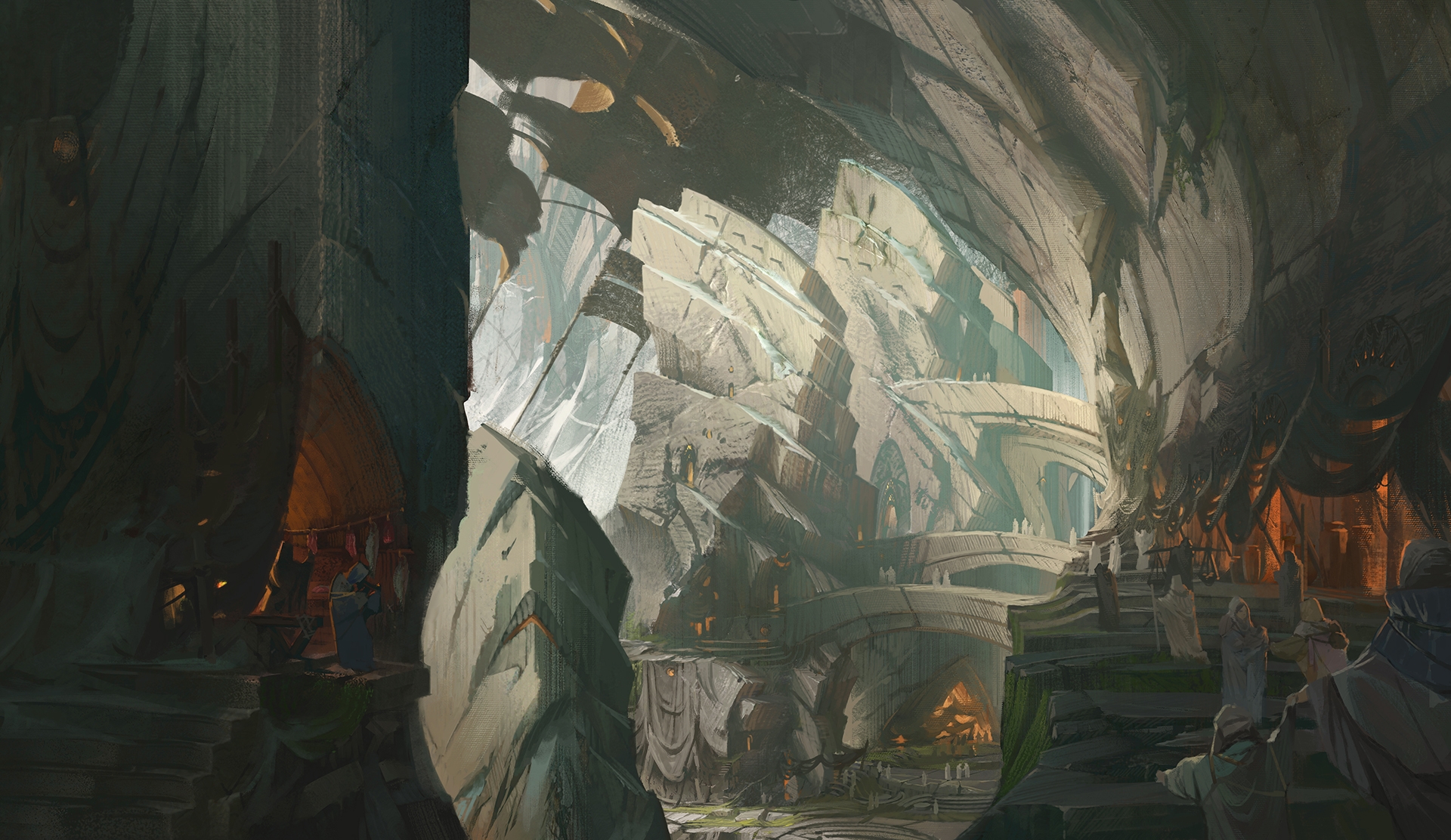
"Be careful leaving your door open during the day; an Igashian may walk through the portal."
Star elves prefer anywhere they can travel as their home. Oftentimes, they will incorporate the core architecture and themes of their motherland into the arrangement of homes they live in elsewhere.
Peering above all as the highest mountain in Volantis, Mount Stargon sits at the edge of the Lauttersänger Mountain Range, of which the Wandersong of Igashu claims as their capital in the gendarme at the peak. Past the rolling hills and mounds the Empire and Gales call their home, large stretches of plains and sloped foothills see roaming herds and travelling caravans in and out of the land.
The architecture of their homeland makes use of masterfully balanced constructions atop windswept peaks lining the spine of the realm. Carven of stone and sculpted of wood, these abodes integrate into the stone as if they had grown out of it, so seamlessly is the masonry. Complex layouts based on geometric formulae and angles place their stores and offices, and they make use of every inch of the mountainside.
Travellers are often terrified of the heights, as Stargon and the surrounding mountains feature sheer drops from location to location. This is traveled by hang gliders for long distance, and tightropes for shorter distances. Appalled is the acrophobic to learn that those within Stargon will traverse tightropes over drops of certain death as if casually strolling along a grounded path. They also happen to be fond of using grey glass in their windows, and putting their preferred constellations on roofs of black, as if under the night sky.
Government & Social Hierarchy

"Let your feet rule your ways"
Fond of calling their government an "ideocracy", the Wandersong is governed by philosophers, and as such moves quite slowly. Much thought is given to most matters of importance, that some compare the legislative powers of Igashu as slow and drawn out as those of the Underkingdom; only in jest, as nothing could compare to the drawn out process of dwarven politics. Their capital sits at the gendarme upon Mount Stargon, and a great deal of their consulting and rumination is into the skies above. Scanning the skies above for celestial communications is thought to be more illuminating on a topic than consulting amongst others who also seek enlightenment on the matter. All are able to look to the stars, but a dedicated circle known as the Stellate are said to be the best in the realm at discerning what the stars have to say.
When the skies do not hold the answer, the Shambali Monastery does. Many of the highest ranking monks within the monastery sit upon, or have sat upon the Stellate, and are revered as being the furthest along on the path to Arete. These are not the only monks in the Wandersong, but those within Shambali are said to have "fully realized the potential of their inherit function." Excellent in moral virtue and wisdom, it is understood that a word of advice or ruling from on high at the Monastery is the law.
It is said that at the head of the Shambali Monastery is the true ruler of philosophy and government, an undying ghost the likes of which none can explain...
Below the skies, below the Stellate and below the Monastery are the Evincers. These are local positions within town governments or even small groups, with the purpose of discovering or revealing things of importance. Investigators, some may call them.
All in all, the government of the Wandersong is rather poorly unified, with a weak law governing them, as they fit in well with other culture's governments. Oftentimes they resort to magickal prowess to their level of respect.
In rare times that the Wandersong is in need of a leader, the Stellate will be implored to look to the skies for wisdom from the Great Panther. If a word is received in the heavens, the Monks of Shambali will deliberate for a time, and will elect a ruler amongst their people for as long as needed. A Sopharch is elected, the best amongst them, and in these times the Star Elves are truly united, and unbreakable. After the time has passed for their need, the Sopharch will step down, without anyone to replace them, and the Wandersong will resume their loose-governed ways.
Within the social hierarchy of the Star Elves, those who are well traveled are well respected. Anyone capable of having a deep conversation on just about anything is seen as wise, while those who feel that a book on the 27 types of stone lining a mountain as boring, to be dull. Where other cultures may tire of cheery and adventurous personalities, the Star Elves relish it. If you are willing to join them on harebrained adventures, you likely be seen as a friend in their social sphere.
Gender roles are relatively equal in the Wandersong, though those of magickal aptitude are usually in more powerful positions. Those in the lower levels of society with no magickal aptitude follow suite in the ways of those that are steeped in magicks, looking down at other cultures which do not practice magick.
Their society frequently changes what is in, and what is out of fashion. As they constantly are interfacing with other cultures, Star Elves bring with them ideas from around the continent; a trendy hairpin from the lands of Galen, or perhaps a new style of advanced belt from Joagundr, or maybe even a new way to dye their dresses with Igashian skill.
Weapons & Military

Kronril is reserved for officers and others of great esteem, being tasted to mine and then refine said armaments in great bouts of pomp and circumstance. Freezeflame is found once more in their armaments, with weapons of flame and heated countenance swinging through the air to singe and sunder foe.
The weapons of the Empire are the most common armaments seen in Volantis, making them a staple of warfare. Swords were the primary weapon of warfare, used by knights, nobles, and foot soldiers alike. They came in various shapes and sizes, including broadswords, arming swords, and longswords, designed for cutting, thrusting, and parrying. Spears and polearms were the choice of mounted cavalry upon destriers or even those in military formations. Maces, axes, warhammers, bows and crowsbows and the rare arbalest are all powerful weapons of war seen on both foot infantry and horseback combatants.
 As for armor, plate armor is reserved only for those who can afford such. Though Emperium cuts the cost of plate armor down, it does not last as long. However, middling Noblemen who go to war can often been seen wearing Emperium armor, though those of more higher status can afford a full steel armor of plate and mail. The majority of other combatants wear coif paddings on their head along with open helmets, chainmail and gambeson for their body, and other leather and cloth and thin metal armaments.
The military organization consists of Men-at-Arms, professional soldiers who make up the core of Imperial soldiers. They are well-trained, disciplined, and equipped with armor and weapons provided by their lords. Below them sit peasant levies, which are raised during times of war to supplement the professional forces. Levy troops are often armed with simple weapons such as spears, bows, and farm implements, and lack the training and equipment of professional soldiers. Above these troops are the Knights and Nobles, those who have fought many battles and are able to live to tell the tale. They are often outfitted with their own personal Destrier and lance, and were trained in both leading cavalry and single combat. Above them all are the Paladins and Templars; holy knights of Artex, blessed by The Father's Light and filled with holy vindication to lead entire armies at the behest of the Emperor of Man. They often are generals, expert tacticians, or exceptional roaming swords for hire of no compare.
A unique practice of the Empire's military is to invoke the Rufung Ritual. This is an open challenge towards the foes before them, by depriving them of their divine protection. An Imperial Paladin will formally offer the protection of the foreign deity under the Solar Pantheon, ensuring a new cult will form in Exandria for them. Should this request be rejected (and as it happens, it often is), the opposing deities are said to do battle with Artex and his Heavenly Host.
Emperium is the metal of choice for nearly all metal armaments, though more noble status begets the use of proper steel. The most elite leaders, from officers to generals, will employ the rare usage of Molzen, a fiery metal capable of explosive damage, and Templars and Paladins will choose to use their holy armaments blessed by their own enchanters.
Martial Arts. Bladed Tonfas. 3 Section Staves.
Music & Art

"The song of our people, the song of your home."
The Estreli'Luari are not called the Wandersong for little reason. Steeped into music and dance are the people of Igashu, with a song on their lips at most times of the day. A song for rising and a song for resting, a poem for travel and a ballad for working. Much of the cultures of Volantis have Star Elves to thank for their songs and origins.
Though they have a wide repertoire of vocal techniques and songs, they are widely known for their kulning. Such are their mountains that this type of singing can reverberate for miles, bouncing down or up the mountain in sonorous tones. Often this is accompanied by a stampede of their various herding animals, so sightseers have to stay vigilant. When they are not calling their herd in song, the typical songwork of the Wandersong is highly expansive and expressive. In most works though, they have a preference for coloratura, or trappings to their singing. Loud and long trills, runs and ornamentation can be added to a standard piece of songwriting, such that a new song is made on the spot, unique to the vocalist. When they are wandering in the hills and valleys of the world, they sing what can be described as yodelling, but much slower than that of the Imperials.
Art is prolifically created in the lands they live in as well as those that they travel to. Great murals painted into mountainsides are a key indicator of Igashian holdings. Most art is rather mobile however, painted on scrolls for portability. Painted or embroidered on either cotton or cloud cotton, celestial or terrestrial motifs in sacred geometric patterns are stored and kept with the painter. Often, Star Elves will have their art be a living document, expanding and growing as their travels expand and their story develops. These scrolls are called wagosh, and the wagosh of elder elves are truly masterpieces. Whether wagosh or more stationary art, themes of symmetry abound. Whether that be in the dichotomy of warm and cool tones, or the symbolism in using stone and oils in a mural, balance in all things reaches even their art.
Of course, as many in the lands are away, the Star Elves love their festivals. Some may even say too much. The Wandersong has by far the most amount of festivals and holidays in the land; they even have a calendar with just holidays on it, separate from the typical Imperial calendar. Great standing bells carven of their mountains with geometric precision announce most festivals with a hypnotic sound, inciting must joy and of course, song and dance.
As seen in their fashion, the cultural artwork of memorial tapestries is practiced strongly by Star Elves and all elves for that matter. The Star Elves reconstitute the typical cultural trend of weaving one's heritage and history into cloth by means of clothing. Their clothes often feature stories and recollections of their far-flung travels, growing more elaborate at the conclusion of each venture. The roofs of their houses also feature tapestries set with stars and their people's stories.
For a relaxing game, star elves love to play Pītasowin, a variant of carrom they have invented, where one carefully flicks a polished stone across a wooden table to knock other stones out of place as well as to settle specific colors into appropriate zones. A game of precision and dexterity, Pītasowin is shared by many cultures as a game of skill, one which the Mer enjoy.
Magick

"The One is in All; the All is in the One"
Similar to their cousins in the Moon Elves, the Star Elves are very open to most Dominions of magick. Magick, after all, isn't discriminatory, and the Wandersong citizens follow in that path; whether of Deific or Thaumiturgical Arts, Enlightened or Umbral, a Star Elf holds respect for all masters of their craft, and looks down upon those who squander their abilities and studies. It is the magister who makes the magick; those who practice the Umbral Arts only make foul the reputation of a potentially helpful magick for all.
However, this does not exempt Magisters from disrupting the natural way of things. Just as Star Elves prefer a hands-off approach to the realm, those that actively meddle with reality, with or without powers of magick, are shunned and often acted against. As Star Elves are open to most magicks, they tend to have masters in many fields, sometimes even in fields they shouldn't. It is one of the greatest grudges of the dwarves upon their Wall of Wrath, that a Star Elf stole their secrets of Runeforging, many generations ago. Though Stargon has officially decreed that they have no Runesmiths in their holds, the dwarves refuse to believe in the elves, even centuries later.
Of all the magicks, it is of no shock that the ever secretive and amazingly powerful Astral Sorcery is a favorite of the Star Elves. The Sacred Geometry of the Stars is said to be imprinted upon Volantis, and much of their buildings, artistic designs and even farmland are constructed in particular geometric shapes to channel this power. Permanent constellations sit above the circles that house Astral Sorcerers, such is the power of their magick. They travel with Star Catchers, woven with mystical threads and dangling with glass beads and polished stone to capture the night's light. As rare as the magick is outside of Mount Stargon, it is just as rare within, as even Star Elves are struck with awe at a display of stellar might.
Others
"Amidst a land filled with evil and war, the Star Elves seek to be the change they want in the world."
While Moon Elves are secluded and ritualistic and Sun Elves are apparent and orderly, Star Elves might engage in a more open and dynamic relationship with other races, actively seeking alliances and understanding. There is much debate on whether the astral influence of the stars applies to just Star Elves, everyone, or even only those not of Estrela’Luari blood.
Dwarves: To no surprise, even the amicable and friendly Star Elves have found to be in the ill will of the Underkingdom. Having very little interaction with the Ironfists, Igashu is often lumped in with the errors of their sibling nations. Rimebeards are a coin flip on whether or not they trust the Star Elves that infrequently travel into their mountains for stargazing. Glassaxes don't have much reason to dislike Star Elves, but the frequent of the slur "knife-ear" is wearisome on pointed ears.
Elves: Having separated themselves not once but twice from their sibling nations, the Star Elves find the squabbling of the Sun and Moon Elves childish, and their obsession with the Sun and Moon ignorant. Their first separation being with the Sun Elves, citizens of Igashu are put-off by the presence of a Solarate citizen. Overbearing and arrogant, they are hard to talk to and not worth the time, constantly reminding them of their so-called "Planar Ambit" and asked to rejoin the fold. The citizens of Elunestra are more warmly regarded, but both nations are well aware of the reason why they split in the first place, over philosophy of the world and what to do with knowledge. Talk of neglecting their purpose is also found in the mouths of Moon Elves, but Star Elves manage to move past this, even if their cousins cannot.
Humans: Star Elves mostly frequent human cities all over, and are welcomed more or less by all. Easy to get along with the Gales and Culias, as their shared easy-going nature brings peace within their peoples. The Okami Conglomerate sees much trade with the Wandersong of Igashu as well, as neutrality is valued in similar vein to coin. Uniquely, the Star Elves are some of the few who gain access to the Toklo Wastes and the lands of the Joagun to dwell on the stars together. The Volk are also friendly, though a friendly Volk is a misnomer. Though the Empire sees many elves in their lands, the Star Elves are certainly not exempt from the prejudice experienced by all in the xenophobic state.
Conclave - Mer: As in all things, the Star Elves are neutral on the Conclave, or rather mixed. They have traveled the lands for ages, and have seen the good and bad of all races, from elf to dwarf to man. Opinions on the Mer in particular tend to vary depending on where the Star Elf is from; those that frequent the Aranthas Desert or even the Nightfall into the city of Divan will have very poor views on the Mer, while those who have interacted with them elsewhere and even in their red stained Arumvex's Folly will view them more highly. Those they do get along with trade goods, with Igashians receiving the merwin phu-bee honey, as well as their ceramicware, while star elves exchange specially-made food that lacks their signature spices, for mer cannot handle spicy food.
Conclave - Ophidian: As there exists a wide range of dragonborne and draconic creatures, a general opinion of them is hard to gather from the Star Elves. Their ambition is viewed sometimes to be over zealous, and the Moon Elves could be a bad influence on them. They will not shy from interacting with them however, although as with all elves, their egregious sins of the past cannot be forgotten in the Age of Scales.
Naming Conventions
((OOC Name Generator Inspiration: Name Generator))
Last names are often conjunctions of Adjective+Noun.
They are fond of palindromes, and such are their family names. Often, their family names are left out, and are just for lineage purposes.
Male name examples:
Caelithar Drasard Burningsong, Veyndor Osiso Brightblade, Thalorien Aranor Starcrest, Aurethion Uru Gleamspire, Selvandar Unalanu Lighthaven, Vaelithar Oranaro Duskwind, Orionthas Ororo Silverveil, Eryndorion Erevere Skyshard, Lunareth Nalan Solvandar, Maerioneth Dreammeard Starlance, Veylithar Seles Dawnseeker, Altharion Rylilyr Zephyrglow, Sylvarion Lerel Nightflare, Elionthar Nevereven Sunweaver, Corathion Silverevlis Starborn, Vaerindor Eeree Moonward, Therionas Melom Brightgaze, Orrivandar Nynanyn Celestborn, Faelthion Oriro Lightstride, Zephyriel Ralar Duskflare, Erynnarion Azaraz Voidgleam
Female name examples
Serenya Ara Starveil, Lyrielle Liril Lightwhisper, Vaelira Orooro Dawnspire, Lómeni Ulu Silverglide, Olyndra Edalade Starlace, Aielia Siris Nightbloom, Niverin Aviva Skysong, Thalindra Aruna Crestfall, Caerithr Iniini Bluegleam, Olyndra Isasi Starlace, Isyrae Eleele Celestborn, Maeriveth Amima Lumenfall, Sylthira Aviva Frostgleam, Aeloria Enene Dreamtide, Velthwen Aellea Sunpetal, Nymeris Eze Cloudveil, Saelithra Ere Etherbloom, Quenyra Ilali Starpetra, Lunithiel Aziza Mistdancer, Oravelle Ilini Moonpetal, Fayndra Uvalu Gleamsong, Yllariel Aielia Starbloom, Celaenya Avava Lightweave
Important Figures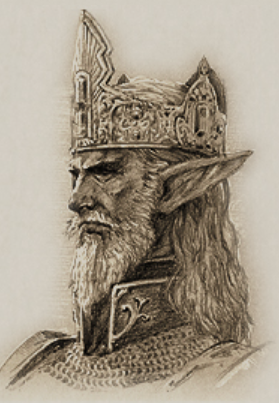
General Vindicator: A towering machination of both man and metal, General Vindicator was a Soulwrought, a mechanical being powered with a real soul forged in the lands of the Okami. More powerful than a simple Automaton, General Vindicator had been a military leader of the armies of the Empire before dying, swearing his service to not end in mere death. He was feared by all, regardless if they were Imperial or not, and was known for his charisma.
Dragon Emperor Mockob: Numerous were the line of Dragon Emperors in the 3rd Age, with many doing impressive deeds both tyrannical and powerful, but Dragon Emperor Mockob's name endures for his draconic intellect, and his love for appearing before his people for them to gaze upon his new Dragonborn form. Where many other Emperors chose to rule in the shadows for fear of the public opinion of their new forms, Mockob cared naught for ill will, feeling more than capable to handle it.
Sir Radzig the Noble: A long lived Nobleman and Knight who was known for his long white hair, Sir Radzig was said to have the mannerisms of a calm fellow but the fighting heart of a lion. He joined the Templar Lionhearts as the only non-Magisters within their ranks, and is known for his questing battles deep within the outskirts of Imperial lands.
Katarina Vlchek: The shining example set for all Paladins everywhere within the Torches, Paladin Vlchek was a woman of piercing blue eyes and a confident disposition and natural leadership. She known for her participation in the unification of a handful of border provinces ruled by disgruntled Lords, whom she placated and united under one banner to put an end to a budding civil war.
Prime Lawyer Jaro Husák: Founder of the Reformation, Jaro Husák was an at the time radical heretic against Rayism, the most numerous denomination of Cynosurians in the early days of the Empire. His actions are credited with the eventual formation of the Church of the Risen Son, and some claim Jaro to be it's founder, though the general acceptance is that Artex founded the church himself before ascending.
Dragonrider Rowan Heartbind: Claimed to have rode upon an Ophidian mount to aid the Conclave in their fight against the God of Dragons Arumvex in an age before mankind had civilization, during the Age of Scales.
Emperor Artex: The Ego Emperor. Greatest of all the Emperors of Man, reigned during the Triunal Alliance between Man, Dwarf, and Elf within their united city of Janna. Such was Artex's influence and beloved nature in spite of his generally cruel ways that the Cynosurian faith believes him to be the Son of Solarius their Overgod, sent down from the heavens to lead them into an unprecedented golden age.
Reilo Hardwin: An enigmatic man who's goal was to establish colleges and schools as far as Mankind could touch. Through his efforts in the latter half of the Age of Legend were the populous of man educated in the ways of the world, with the Star Elves lending aid in offering of their knowledge. Many schools are still standing to this day, with a few directly named after him.
The Wandering Vagrant: An extraordinarily powerful magickian capable of learning more domains of magicks than any other, as well as being far more proficient in them than those who specialized in just one. Most notable of this wizard's skills were his masterful skills at an unknown school of magick said to have been lost to time. No nation could claim the wizard as their own, for he would only appear in times of great need to stop catastrophe, impart wisdom, and then vanish on the claim to apprehend some unseen threat. Many whispers still stand of this being an unnamed god of magick, though no proof has been garnered...
Emperor Wellins: Herod Wellins was the Emperor during the Chaos Incursion of the Age of Destiny, though his participation in the battles were not of great significance.
Tilawen Nilorian, Windwalker: While Star Elves are already known for their tendancy to wander, the Windwalker is known for their prolific nature of travel. Tilawen is known for having seen every sight, every experience and every vista the lands of Volantis has to offer. She is the shining example to all Star Elves that such is attainable, and is something worth striving for.
Aaru Ashaniel: When the Doombringer brought onto the mortal realms the Chaos Incursions at the end of the 3rd Age, it was Aaru the Star Elf who ensured the continuation of the Elven People. With their mastery over Arcane Magick, combined with occultic Sanguine Alchemy made in tandem with the unsavory Divan, great flesh golems of magickal power and strength razed the fields of demonic blight creeping onto the lands of Volantis.
Anjali Lómelindë: Known by many in the Empire of Man as the bringer of knowledge and enlightenment, this Star Elf took inspiration from Prophet Vaeloria Lumindra, who brought the faith of the Solar Pantheon to man. Anjali brought instead knowledge and education, society and structure to the uncultured masses of man. The modern understanding of college and school was modelled after what Anjali spent centuries developing, with much reform and restructuring over the years.
Star elves are like Zenyatta, and his temple. Moon elves have Ramattra.
The Monks: Tibetan monks who climb mountains and meditate and FLOAT
Zarothas: Founder of astrology, Zarothas is renown for discovering the relations between celestial bodies and those on our world. She is said to have charted the movement of the stars and the heavenly bodies, and was able to even fortell future events by studying their paths.
Star elven researcher/astronomer who ventured into the Joagundr mountains
Historian, explorer
politician who made the national colleges
activist who worked to get the Ōkami and empire to work together, but they ended up with their head on a pike. Some important trade was still set up though, ensuring vital trade to crucial poor and rural areas
The Stargazer - after the abandonment of (name), the Star Elves were lost in the world, with no guidance or path to follow. It was the Stargazer who aligned her people, pointing them skyward yet again. She is the founder of astrology, charting the skies and demarcating the bounds of constellations. Wise men, elf, mer and dwarf came far and wide to learn of this new knowledge of the heavens.
Maserot
The Star elves have the Archons which are an “evil” group that seeks to use astral sorcery or blood Magick or demon magick to strengthen their Pleuroma to make a black star.
Aegæon:
Speaker of the Stars: Our business here is not to know all things, but those which concern our conduct. If we can find out those measures, whereby a rational creature may and ought to govern his opinions, and actions depending thereon, we need not to be troubled that some other things escape our knowledge.
A star elven polymath who was aw astronomer, astrologer, medical doctor, natural and supernatural philosopher. Laid the groundwork for the illustrious center of learning. He lived in a place where, despite two conquests of various religious factions, the occult sciences were allowed to persist. These people were called the sabyans, People of the Scroll
Legends & Myths

The Stone Golems: An exceptionally old myth, that claims in the beginnings of the lifespan of Man, even before the Ophidian Wars, these lumbering, expressionless creatures waged war, and then became friends with Man. What followed were the employment of human armies alongside these great beings, which some surviving ancient texts credit the Stone Golems to saving Mankind from extinction. It is unknown what happened to these beings, as only one has ever been seen since these ancient wars.
The Slumbering Giant: Mankind knows that they were not the first beings to exist in the world. However, with the discovery of an untold trove of indecipherable items made out of Relic Metal in the Age of Destiny, all in a massive underground tunnel system that seemed to be the outline of a body, more questions stand to find out if there were beings before even the dwarves and elves...
The Trinary Alliance: A period in time where, following the end of the Ophidian Wars, Man, Elf and Dwarf all lives as one within a marvelous capital at the seat of the Interior. It was here that the Empire of Man was to be first conceptualized, but would not be born until much later in the story of man.
The 12th Battalion: An exceptionally powerful and talented group of mixed magickians from all Dominions of magick, who's efforts were to be the vanguard against the final defense from the Doombringer's Chaos Incursion. All but 2 fell in battle, with both vanishing shortly after the war. The Vault of Fallen Heros lays in the Empire's land where this battalion is buried, along with many others who's lives were lost during this time.
The Dragon Emperors: A line of Emperors who turned out to be governed by an Archdrake, these powerful rulers brought much destruction upon the Empire's neighbors, as well as itself. Some say that they were the greatest rulers of Volantis, and that their ways should be emulated once more.
Impermanence Laws: Once upon a time, the governing body of the Empire could enforce what are known as Impermanence Laws with little to no voting required, under the guise of solving a pressing matter that did not allow the time of the slow moving court, or simply because they were testing a legislative doctrine. The common rebuttal the Lawmen would give is that if one didn't like it, the Impermanence Laws wouldn't be around forever; if it doesn't they'll abolish it. Needless to say, a great deal of corruption ensued.
It is said that one of the notable Impermanence Laws regarded that of Warpwrights, teleporters of incredible rarity. It mandated that all of these rare Magisters must turn themselves in and be registered. The hushed story is that a Warpwright "accidentally" teleported in on a local king having an affair. Of course, no one did. One man did turn himself in however, supposedly trying to see what their secrets were and if he would learn something if he acted like one. He was hung in the square for the king to see. Warpwrights were from then on a secretive organization.
The Accepting Cynosurians: Once upon a time in the early days of the Empire, the faith used to allow the worship of other gods, before their conversion into the Cynosurian Faith and the sole worship of The Coruscated. The Ego Emperor Artex rose to power and declared all faiths that were not Cynosurian would be heretical, and only those who were following the worship of himself would be recognized in the noble courts.
Dragon's Collar: Wildly believed to simply be a novelty and holding no magickal power, this collar of Drägurum is scribed with Wyrmlore glyphs said to be able to control a Dragon should one survive attempting to put it around one's neck. Unfortunately it is split in half by the actions of it's user, Rowan Heartbind, upon his final ride with his final ride.
Master Spelltome of Exandria: As is custom of all Arcane Tomes, one must read out of a spellbook to cast magick, lest you suffer the curse of forgetfulness. However, rather than having all Magisters secluded with their own private works and accomplishments, the wise minds of Exandria's Arcadia, the college for arcane academia, constructed a master tome holding all the known spells of the magisters in the Empire. It sat upon a grand pedestal within the walls of Arcadia, and magisters of all kinds, from wizards and witches to druids and alchemists all gathered daily to study from the tome and prepare their spells for the day. The college is known for it's remarkably short life, and the book has been relocated from the slithering mass of ooze that once was the college.
Paladin Vlchek's Amulet: Supremely valuable to the Paladin Torches, the shining example of their order wore a golden amulet enchanted with pure fire which is said to be able to imbue Paladins who wear it with a mere portion of her conviction, enough to drive one to great deeds.
The Mantle of Ego: The mortal crown of the Ego Emperor Artex, claimed to be forged of pure Ardent by dwarven hands, and enchanted with cut gemstones arrayed in a chromatic rainbow filled with elvish magicks. No longer needing such meager trophies once he ascended to his Father's place as Overgod, Artex left behind this relic for the following Emperors to bear. It is fabled that any who looked upon Artex with his crown donned were compelled to listen to his every word, and any who would dare don the crown would be stricken with madness, unworthy.
Warbanner of the 12th Battalion: An exceptionally powerful and talented group of mixed magickians from all Dominions of magick, this served as their banner to be flown during their famous assault against the Doombringer in the Chaos Incursions. It flies now in the Vault of Fallen Heros.
Justiciar's Memorandum: A one handed mace (depending on the story teller) which glows with a golden light at it's core, this holy artifact is enchanted by not Templar or Paladin Magicks, but is believed to be from Luminara the Everburning herself, Wife of Solarius the Father. Her holy light is imbued within the mace, and is a reminder to all that the Law is already within the world, and any who do not follow it have not an excuse for their actions.
Planar Map: The life's work of Zarothas, the founder of astrology. This map is said to have the paths of all celestial bodies charted out, and bears powers of future-sight. With the ability to chart the heavens, one would be able to even travel the stars, so they say...
Zarothas: Founder of astrology, Zarothas is renown for discovering the relations between celestial bodies and those on our world. She is said to have charted the movement of the stars and the heavenly bodies, and was able to even fortell future events by studying their paths.
The Kismet: A bird of fate and providence, who's feathers can change the future?
The Observatory: Deep within the uncharted jungles, where none but the Conclave dare to travel, there is said to be an abandoned celestial observatory, with a telescope claimed to be able to pierce into the heavens themselves. Some say that it was left behind by enterprising Star Elves, but others say the architecture of the location belies another, must more ancient origin...
The Abyssal Dragon: Though most Estreli'Luari deeply fear the grasps of the Dark Stars, there exists the hopeful tale of a hero who not only stood brave against them, but managed to reduce a part of their power. In the times United, [name] confronted the Archon known as the Abyssal Dragon, and cast it down back into Fundament, weakening it's hold on traveling spirits.
They have a fabled Pink Fleuret, like the White Stag. mythical creature of great value.
Silent Moon: The first schism of the elves, in the 3rd Age. At the behest of their Shattered Tribunal, the United Elves constructed a grand ritual of what is fabled to be the greatest Astral Sorcery ritual to ever be attempted, much less completed. The Ritual was said to be to sate their insatiable hunger for immortality, disrupting the intended flow of life, as well as destroying Chaos in it's entirety.
The moon was only frozen in place, allowing the Deep Dark it chased from to overtake and consume it. This forever locked the forces of the Sun to aid the Moon across the bridge, a never-ending defense against the unknowable Night Sky. Upon it's failure did the elves split, heading onto their own, separate destinies.
Sunbreak: Old sins were never forgotten. In a great scheme that spanned the entire 3rd Age, the Moon Elves sought retribution for the damage caused to their lunar body. The Ziggurat of Silence was constructed, and a great quieting of the sun occurred, exactly as intended. They proudly regard the event as "The Day the Sun Wept." It is this event that causes the Sun of Volantis to be a spiral, as well as why the Sun does not shine in what is now known as the Nightfall.
Settigris Schism: The final splitting of the elves, in the 4th age. This event was far less bloody considering the history the elves have for splits, featuring the Moon Elves and Star Elves going their separate ways. Their matters were of retribution over the death of an elf by the hands of the Sun Elves, and, unable to reconcile their differences on the matter, went their own ways.
The belief of the Rainbow Crow (or something else.) 2 stories. One is that there was a great fire, and the crow saved everyone, carrying them from the fire, but it's feathers were burned to soot and lost of all of it's color. The other is that there was a terribly cold winter, and it went to heaven and got the divine fire and caried it back for all, but at the cost of burning itself.
The outsider killed a god/archon and changed a constellation. Cutting the throat of the bull. Maybe tied with Rhiaa’Turask.
Tethy’s Wake: A set of Pauldrons (boots or whatever) that are wrapped in shadow, fashioned with powerful magick from the unified Moon-Star Elven city. Despite seeing centuries of use and having been worn by steps the entire continent many times over, these boots are still supple and lavishly comfortable, providing the owner the ability to walk in both this and other realms…
The Dragon Egg of xyz: Taken from their kin the Moon Elves for their safety.
https://en.wikipedia.org/wiki/King_asleep_in_mountain
Ancient Star Elven Prince is still alive. Perhaps he is a god. Perhaps he is waiting for the right time to return and make everything right. Heaven on Earth.
A demon leader comes to do some evil, and a lady says “before you do, teach me (the divine name)” and he does and she’s immediately turned into a constellation, escaping him.
The Original Enchiridion Magicka: The ever-popular book, written by Lakshmi the Estrela'Lurin of the Albedo Observatory, was stricken of a secret Tradition of magick. However, some believe that the original that Lakshmi kept for herself still perseveres through the ages, with the secrets of this Tradition scribed within...
The Pale Spear from 40k
Hand of the Starforger
The Shambali masters have some unique magick no where else seen…
Maybe purple eyes signify what the Star Elves claim to be a pure lineage to the Elves United?
Maybe they believe they came from the stars and are trying to come home?
Festivals & Holidays
Vigil of Fallen Heros
During the Dominion of Hoarpall
A celebration of the life and sacrifice of the noble heros who laid down their lives during the Cataclysm of the 3rd Age: Age of Legend to fight off the scourge of Chaos. Some cultures use this opportunity to pay respect to fallen relatives as well, a remembrance of all who came before, shown frequently in the form of gifts or walking vigil processions, to imitate the mobilization of war.
Day of Wiles
During the Dominion of Stormharrow
On this day, a great commotion is incited, with bards and jesters the across the lands creating grand displays of buffoonery and art in an effort to shake off the winter wiles. Dancing and other absurdities commence with folks of all status and class, and sometimes entire dancing bands form spontaneously within cities and villages. This event has been the focus of many reforms, and outright banned many times before for inciting chaos in the lands. This event coincides with the last frost and beginning of the early planting season.
Flue's Day
During the Dominion of Vernalfrond
An exciting day where straw and wood mockeries of dragons and other Ophidian creatures are created and destroyed, to celebrate victory many centuries ago in the 2nd Age: Age of Scales. This is the oldest known celebration in the lands (Believed to be 2000+ years old), and is held by all. Children frequently wear horns (real or crafted) and run around villages roaring at adults for sport, who are expected to either play dead, or chase the children off.
Son's Day
During the Dominion of Soluary
On the longest day of the year, the Summer Solstice, the Solar Pantheon's Overgod, Artex, The Son of Man is celebrated in all of his radiant glory. To Him are burnt offerings brought, to be deemed as pleasing and assuaging to his senses. Vows are renewed, faiths strengthened, and all windows opened to allow light into homes, with many of the rich wearing extravagant sun-themed attired such as gilded necklaces and pendants, or even headdresses of gold as fashionable praise to He who has Risen.
Passion Day
During the Dominion of Luminary
Following a month after the celebrations of Sun's Day, Passion Day is in honor of Luminara the Everburning, Mother of Artex and Wife of Solarius, whom Solarius fought all of the Chaos Gods to make his Betrothed. Marriage vows are officiated or rededicated on this day, adolescent's romances and passions pursued, and those who have family gather to enjoy the comradery of fellowship. Alms are sometimes given to give relief to those who do not have, and honor given to those who give.
Garrowin's Gallup
During the Dominion of Somerset
This holiday is in celebration of the legendary Monster Hunter Garrowin, who tamed the feral lands in ages of yore for the safety of the Empire's expansion. Today it coincides with the harvesting of crops this time of year, with Hunters upon steeds and mounts of various sizes competing in both number and size of game and/or monsters slain and brought back to their village in both sport and survival.
Mer-der's Eve
During the Dominion of Eye's Mirth
A light mockery of the Conclave, this holiday is one of spooky sensations and tricks in demand of treats, where many costumes of grotesque and imposing design are constructed to lightly terrorize towns and villages in roving bands of troublemakers.
Elfsgiving
During the Dominion of Eventide
In recognition of the once-aid the Sun Elves had given the Empire of Man many centuries ago in the form of enlightenment of the Solar Pantheon, some Imperials deigned to prepare great feasts to elves of all types, which soon evolved into a pure giving of thanks for all.
Dwünsmas
During the Dominion of Icewind
A holiday with sour roots best lightly mentioned, this is an aptly named giving of gifts forcibly started upon the Underkingdom of Khazgarim. Wise Dwarves of the Austral South were demanded by the Empire to bring gifts to their king, to be symbolic of the Dwarves not being controlled by their greed. The Dwarves eventually turned this into an event where they would get gifts themselves as well, leading to what is now know as Dwünsmas. All races often participate, despite the name, and gifts flow from all cultures. It is custom to leave a small cookie in the shape of a sun within a gift's packaging.
https://en.wikipedia.org/wiki/Navaratri
Tibetan singing bowl, many festivals and dance and song. Cham dance.
Monks, martial arts.
Cow releasing season
Nine Nights Ritual
- They clean their utensils, windows, doors and door frames, they start all education on this day, they clean their entire factories, they make grand diases and construct scenes from around the world and place mud dioramas of their gods into them, they don't study anything new on these days, once they're done they put the mud sculptures into the river, all in worship of their god of many facets for one facet on each of the 9 days, and then on the tenth they learn new things and start new education, because this is the "Victorious 10th day" where their god slew a demon.
(Or it is a ritual on where they do 9 baptisms for each of the Archons to showcase the victory the Dark Princess had over the)
civil twilight vs astronomical twilight Vs nautical twilight
https://en.m.wikipedia.org/wiki/Dashain
https://en.m.wikipedia.org/wiki/Tihar_(festival)
History
Synopsis: Very lengthy is the history of the Empire, such that a summary of their tenure within Animus Liber could fill up many a dusty tome. The empire has had very tumultuous periods, where kingdoms have broken off through revolts or other conquests, culture constantly changing, social castes flipping positions, the economy shifting and it's focus and aims changing. It doesn't have one singular arc to it's history, but rather repeated trials, reformations and restorations throughout it's history. For starters, their saga begins in the 2nd Age, the Age of Scales.
Late to the scene of the world some may think humans to be, but many humans will point to all they have accomplished in their short tenure as rebuttal. They find their start as disparate tribes, camps and roving bands. With no unity and no direction, as most pre-civilization stories go, battles against tribes and factionism abound. Bound by Chaos as their master, the human people were unified not by nation or creed, but by who had the most power and who could slaughter and pillage their neighbors better. When the rulers of the world, the Ophidians, came for man, mankind put up no fight in their huts and camps. Were it not for the aid of the Sun Elves, Mankind would have been lost. With the aid of the far more advanced Once-United Elves and the Underempire of the dwarves, the Ophidians were abated, and the world shorn of it's shackles to Chaos.
 This entered Mankind into the next age, the Age of Legend. Here they founded the Trinary state of Janna where the remnants of mankind would band together with the forces of dwarves and elves. It was here that the dwarves taught the remnants of man their skills in laborious toil, and did the Sun Elves enlighten man with the faith of the Solar Temple. This lasted for a time, until Artex, who was not yet the Ego Emperor, gathered that Mankind should rule, and that Solarius favored Man before all. These thoughts and subsequent actions led to both the fall of the Trinary state of Janna, as well as the birth of the first Empire of Man. During this time did many great feats of heroism and myth be committed to history, left in the libraries of the world as well as etched into nature itself.
As the First Empire of Man reaches it peak, it does so at the cost of the Dwarven Underempire's crumbling at the hands of the Conclave. Growing to new heights placed the First Empire of Man well for the storm that was brewing ahead. With the now Underkingdom of Khazgarim recouping it's land and stone, the already sundered United Trinity of Elves and the Conclave were hit with the Chaos Incursions. Another very famous and well recorded event; the summary of this world-shaking event is as follows.
The Doombringer, a Tyrant the likes none have ever seen in comparable power, agent of the Chaos Gods, invades upon the Interior. All races join the fight, with nearly all falling. The First Empire of Man bears the brunt of this invasion, and ends up falling to the crimson blade of the Doombringer, his sword drinking the life of the Emperor himself. The crumbling of the Empire however paves the way for the other races to finish the fight, and the tides of Chaos are sent back whence they came. Mankind spreads in a grand diaspora to the various nations around the lands, to lick their grievous wounds.
In the 4th Age, Age of Destiny, all of the modern human nations exist in full force. Where the 3rd Age saw the claiming of land for the Empire of Man from the Underempire of Dwarves and the United Trinity of Elves, the 4th Age bore witness to the unbridled expansionism that man is capable of. This increase in power leads to the rebirth of the Second Empire of Man, which picks up right where it left off before. Sending the conquered Galen off to fight in the Wasteful Wars, the Volkar invasion of the Verdant Wars, the Great War of Volantis against the Moon Elves, Okami and Volkar, much war was seen in the 4th age by the Empire.
The Empire of Man grows into a terrible regime with an impetus of control through never desiring to reach the brink of genocide again. The secretly developed Dragon Emperors were formed, a cruel but incomparably powerful line of rulers guided by what is believed to be an Archdrake behind the scenes. A drastic famine shows its head, and the dominos fall to create an insurrection and the implosion of the Second Empire of Man following a drastic civil war. With this second destruction, more power is given to the distant human powers, namely the Okami, who exist for a short period as the premier human power. A small group of neo-imperials formed a sort of democracy for a time, but were swiftly squashed by the Unitary Solarate. Those that survived left to join with the Culiacán.
Towards the end of the 4th Age, the Holy Empire of Man is formed, with a renewed purpose of adherence to their faith, while tempering themselves of running away with control lest they incite their people's wrath once again. As of the current age, the Age of Darkness/Discovery, the Empire of Man has returned to power, and is poised to soar to heights far greater than ever before, were it not for their gods ignoring their prayers as of late.
For their philosophy: In this there are many similarities with the philosophy of the Moon Elves, in that they too believe in that things must go as they should. Where these schools of thought differ however is how each group chooses to act on such knowledge. The Star elves choose to guide and endure with longsuffering, whereas those of the Moon choose to act and correct more directly, which was the reason for the splitting of the two cultures in centuries past.
The Schism of Stars
The precursors for the Moon and Star elves were one for a time, somewhere in the (Lauttesanger) mountains. Peace was had for a time as the elves licked their wounds. The tranquility would not last forever, as their history followed them. A council was formed to discuss the way forward for their people. Their incessant deliberation was cut short when an elf was found dead in the streets on horseback, an arrow of Sun Elven fletching through his eye. Enraged, the council convened once more, and different sides of the meeting was formed. From here, the story splits many ways. For the Moon Elves, their side of the story is that the other side of the table (which would become the Star Elves) called for peace, to not be like those who created this grief, and to end it here. The other side of the table (which would become the moon elves) were revolted at the inaction at the death of one of their kin, and called for justice, and immediate action. Led by (Ramattra), the nascent Moon Elves took their exit from their siblings, cleaving their people in two and heading deeper into the reaches of the continent.
Star elves believe they, watching their siblings descend into chaos and hate, cast them out? Or maybe they abandoned them and went into the mountains
After the Moon Elves left, the combined city in Mount Stargon became one.
Later, a growing city for magick was being born, led by the Star Elves. Before long, Moon Elven magi we’re at their doors. In their benevolence, the city of Star Elves allowed their outcast siblings in, as well as other nation’s magi. This city of magick (name) grew for a time, before abruptly disappearing without any spectacle. Where it sat, simply was untouched nature one day. This was immmedialty casted as blame onto the meddling acolyte of the Wondermaker, and the Selusion and all Moon Elves were no longer welcome in the Wandersong’s lands again.
The loss of Moctla-Tec became a symbol of the danger of meddling with powers beyond understanding and sparked a period of reckoning for the elves.

Last edited: 6 months ago